Colorado Artificial Intelligence Act (CAIA)
- Jurisdiction: Colorado State
- Status:
Passed - Effective Date:
2026-02-012026-06-30 - Date Added:
2025-09-19(Updated2025-09-30) - Source URL: https://leg.colorado.gov/bills/sb24-205
Summary
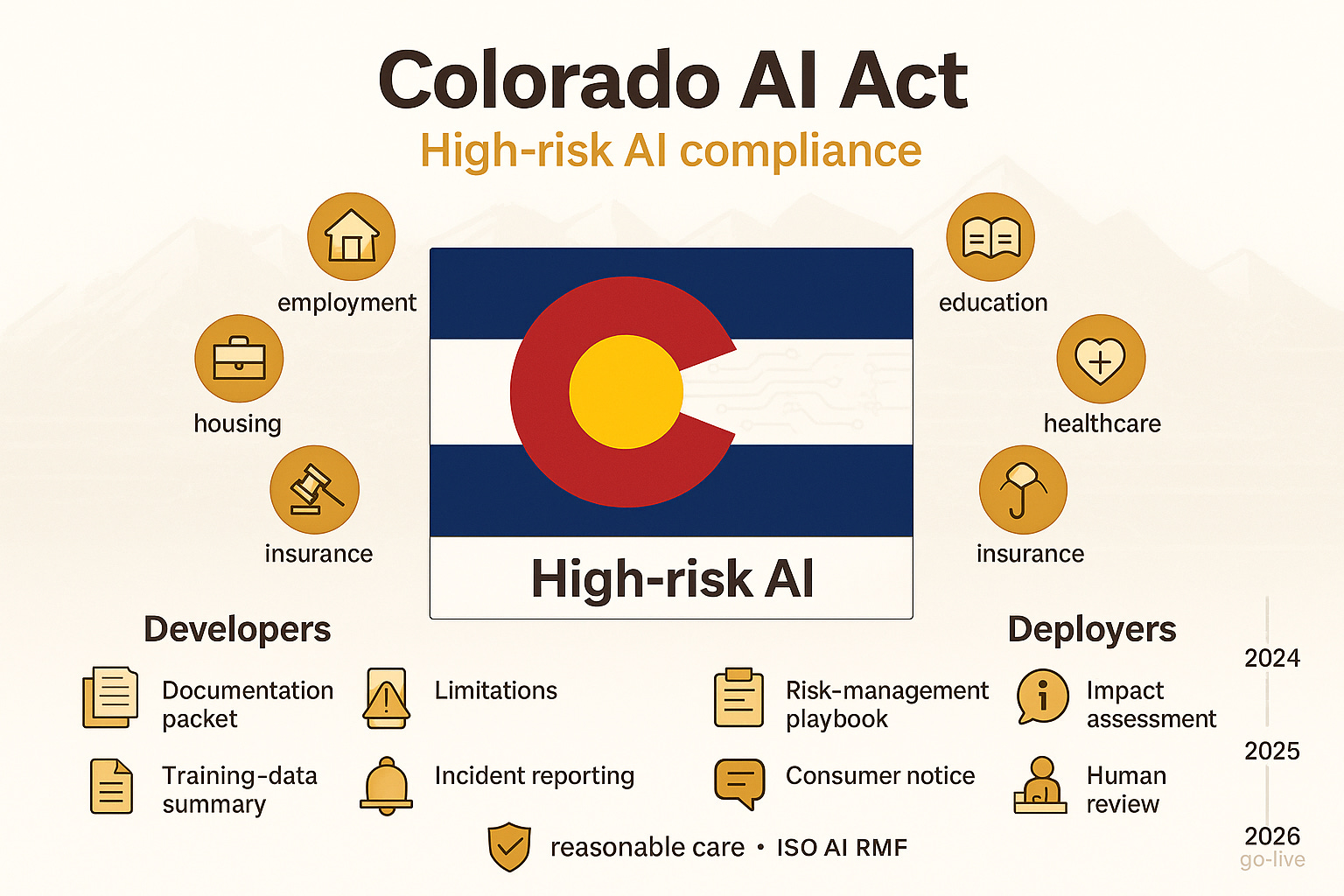
The Colorado Artificial Intelligence Act (CAIA) is a comprehensive state law that regulates the development and deployment of high-risk AI systems in Colorado. Its main aim is to protect consumers from algorithmic discrimination in consequential decisions—such as in employment, housing, healthcare, insurance, legal services, financial services, education, or government services. It imposes obligations on both developers and deployers.
Key Takeaways
- Defines "high-risk" AI systems as those systems that make, or are a substantial factor in making, consequential decisions. These are decisions with a material legal effect or similar significance in domains like employment, housing, healthcare, insurance, education, financial services, legal services, essential government services.
- Developers must use reasonable care to mitigate known or foreseeable risks of algorithmic discrimination, provide documentation, disclosures (training data, system limitations, intended use), share required information with deployers.
- Deployers must maintain risk management programs, conduct impact assessments, provide consumer notice especially when AI is involved in an adverse decision (or “consequential decision”), allow consumer rights like appeals or human review, correct erroneous data.
- Algorithmic discrimination is treated broadly: includes both disparate treatment and disparate impact on the basis of protected characteristics under Colorado or federal law.
- Exemptions are built in: e.g., for small deployers under certain conditions, for certain narrowly defined AI systems, and for entities already regulated under other regimes with substantially equivalent protections.
- Transparency requirements: consumers must be informed when interacting with consumer-facing AI, and especially if an AI system contributes to an adverse or consequential decision.
Additional Sources
- U.S. Legislstion Policy Brief
- Blog post - published 9/25/25; scope, duties, exemptions
- Skadden: What Companies Need To Know — legal commentary
- NatLawReview
Tags
discrimination, consumer-protection, transparency, bias