Convolutional Neural Networks (CNNs)
Overview
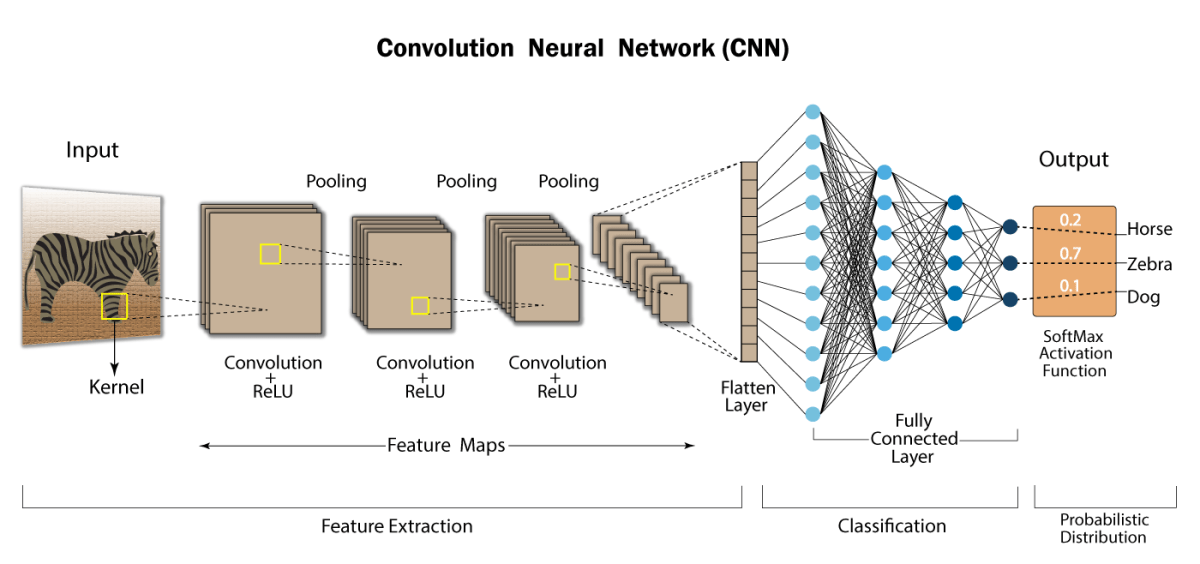
CNNs are a class of neural networks designed to process data with a 2D or 3D grid-like structure, such as images, video or time–frequency audio representations. They rely on learnable convolutional filters that slide across an input to detect local patterns, making them effective at capturing spatial relationships like edges, textures, and other visual features. CNNs were central to many major advances in computer vision throughout the 2010s and remain widely used in applications where spatial pattern extraction is important.
CNNs reduce the number of trainable parameters by applying the same filter at multiple spatial locations, compared to fully connected networks where each weight applies to a single connection. This weight sharing makes CNNs more computationally efficient and easier to train on grid-structured inputs. As depth increases, CNNs combine earlier, simpler features into more abstract representations. Many modern CNN architectures also incorporate techniques such as residual connections, inverted bottlenecks, depthwise separable convolutions, and structured scaling rules, which improve optimization, efficiency, or representational capacity.
Applications and Use Cases
- Image classification
- Object detection (as backbone feature extractors)
- Semantic segmentation
- Medical imaging analysis
- Audio classification
- Real-time or resource-constrained applications
- Deployment on hardware optimized for matrix operations
Popular Architectures
- ResNet
- EfficientNet
- MobileNet
- ConvNeXt
- RegNet
Strengths
- Convolutional layers require fewer parameters than fully connected layers for grid-structured data
- Effective at extracting local spatial patterns
- Supported by mature, widely used implementations in major deep learning frameworks
- Many publicly available pretrained models for classification and related tasks
- Suitable for deployment on hardware optimized for convolutional operations
Drawbacks
- Convolution operations capture local interactions and may not represent long-range dependencies without additional mechanisms
- CNNs are specialized for grid-structured data and require adaptation or preprocessing for other data types
- Performance depends on architectural choices such as kernel size, depth, and block design, which often require manual tuning